
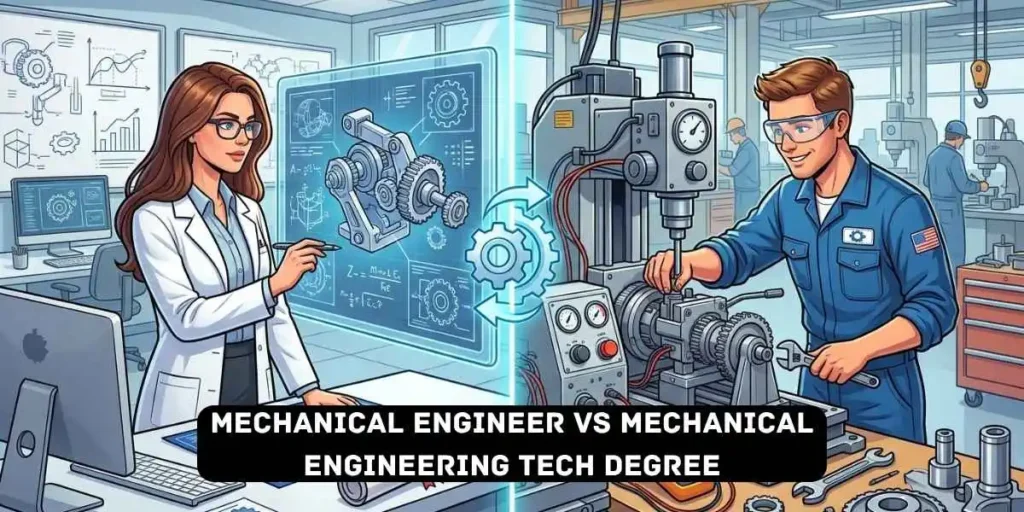
Choosing between a mechanical engineering degree and a mechanical engineering technology degree can quietly shape your entire career, from the kind of work you do every day to how much you earn and how fast you move up. The problem is, most students don’t realize the difference until they’re already deep into a program. On paper, the two paths look almost identical. In reality, one is built around designing and analyzing complex systems, while the other focuses on building, testing, and improving them in the real world. If you want to avoid ending up in the wrong career track, understanding this distinction now can save you years of frustration later.
Mechanical Engineer vs Mechanical Engineering Tech Degree
So you’re trying to figure out if mechanical engineering and mechanical engineering technology are basically the same thing. It’s a fair question, and honestly, a lot of students get confused between the two before picking a degree. They look similar on paper, the names are close, and both put you in engineering careers. But the difference between mechanical engineering and mechanical engineering technology matters a lot for your day-to-day work, your salary, and how far you can go in your field. Getting clear on this before you enroll saves you a lot of headaches later.
Mechanical Engineer Career Overview
Mechanical engineering is one of the broadest engineering fields out there. If a machine moves, spins, generates heat, or transfers energy, a mechanical engineer probably had a hand in designing it. We’re talking turbines, HVAC systems, engines, robotics, medical devices, and more.
According to the U.S. Bureau of Labor Statistics, mechanical engineers earned a median annual wage of $102,320 in May 2024, with employment projected to grow 9% from 2024 to 2034, which is much faster than the average for all occupations. That’s a strong outlook if you’re choosing a long-term career path.
The path to getting there requires a serious academic commitment, especially in math and science. But for students who like solving problems from scratch, not just fixing what’s already built, it’s worth it.
What a Mechanical Engineer Does
A mechanical engineer’s job starts way before anything gets built. They analyze problems, apply engineering principles to develop new designs, and figure out whether a solution is even physically possible.
Mechanical engineers are problem-solvers who use the principles of motion, force, and energy to create products or systems that are safe, efficient, functional, and reliable. They need to consider not just how an object should function, but also the environmental forces it may encounter and the manufacturing processes that will create it.
In practice, a mechanical engineer might design a new car engine component and hand off detailed blueprints to a technologist, who then figures out how to actually manufacture and test it. That division of work happens constantly in real engineering teams, more than the job descriptions make it sound.
Day-to-day, expect to spend time running simulations, writing technical reports, collaborating with cross-functional teams, and refining prototypes. Most mechanical engineers work full time, and some work more than 40 hours a week.
Mechanical Engineering Technology Degree Explained
A mechanical engineering technology degree, often called MET, takes a different angle. Where mechanical engineering emphasizes theoretical concepts and conceptual design, MET focuses on the application of existing technologies and the hands-on side of making things work.
Mechanical engineering technology shares the same foundation as mechanical engineering but emphasizes hands-on problem solving, applying concepts directly through tools, machinery, and equipment. One path leans toward innovation and design, the other toward practical execution.
Think about it this way: a mechanical engineer designs the machine. The mechanical engineering technologist figures out how to build it, test it, and get it running on the factory floor.
In a MET program, coursework often emphasizes hands-on training, using CAD software, operating CNC machines, and managing quality control processes. Students spend more time in labs and less time on advanced theoretical coursework like differential equations or advanced thermodynamics proofs.
Types of Technology Degrees in Engineering
When people say “technology degrees,” they usually mean programs designed to bridge the gap between pure engineering theory and real-world application. MET is one type, but there are others worth knowing:
- Mechanical Engineering Technology (MET): Focused on manufacturing, machine design, troubleshooting, and production.
- Electrical Engineering Technology: Deals with circuits, automation, and electronic systems.
- Civil Engineering Technology: Covers construction management, drafting, and infrastructure support.
- Industrial Engineering Technology: Focuses on process efficiency, quality control, and lean manufacturing.
Each of these is a legitimate degree path. They’re accredited differently than traditional engineering programs, but a degree from an ABET-accredited MET program carries real weight with employers.
Some employers explicitly prefer ME for design and analysis roles but value MET for implementation-focused positions. Many firms hire both and cross-train on the job. So neither path shuts doors. It mostly depends on what kind of work you actually want to do.
How to Become a Mechanical Engineer
The most straightforward route: earn a bachelor’s degree in mechanical engineering from an ABET-accredited program.
Mechanical engineers who sell services to the public must be licensed in all states and the District of Columbia. A Ph.D. is required for engineering faculty positions and some research and development programs.
After your bachelor’s, many engineers pursue the Fundamentals of Engineering (FE) exam and later the Professional Engineer (PE) license. That PE license matters if you ever want to run your own firm or stamp engineering drawings.
Here’s something most people don’t mention: for the PE license, a bachelor’s in mechanical engineering counts as 4 years of qualifying experience, while a MET degree counts for only 2 years, meaning ME graduates can qualify for the PE exam after just 2 years of work experience, versus 4 years for MET graduates. If PE licensure is in your long-term plan, that’s a gap worth knowing about before you choose your degree.
To become a mechanical engineering technologist instead, the education requirements are more flexible. Mechanical engineering technologists and technicians typically need an associate’s degree or other postsecondary training to enter the occupation.
Key Skills Needed in Mechanical Engineering
Both paths need strong problem-solving skills, but the specific skill sets diverge pretty quickly.
For mechanical engineers, the core skills include:
- Advanced mathematics: Calculus, differential equations, linear algebra. You’ll use them constantly, not just in coursework.
- Physics and engineering principles: Thermodynamics, fluid mechanics, materials science, dynamics.
- Computer-aided design (CAD): Tools like SolidWorks, AutoCAD, or CATIA for building and modeling designs.
- Simulation and analysis: Finite element analysis (FEA), computational fluid dynamics (CFD).
- Communication: Writing reports, presenting findings, working with non-engineers.
For mechanical engineering technologists, hands-on skills take priority:
- CAD software and CNC machine operation
- Troubleshooting and quality control
- Manufacturing processes and production management
- Automation and robotics implementation
- Prototype building and product testing
MET coursework covers computerized design, materials science, machine shop tools, quality control principles, and also includes chemistry, physics, fluid and thermal transport, and calculus as it applies to science and engineering fields. It’s not a watered-down curriculum. It’s just pointed in a different direction.
Mechanical Engineer Career Path Overview
Here’s a side-by-side look at how these two paths compare across key areas:
| Factor | Mechanical Engineering (ME) | Mechanical Engineering Technology (MET) |
|---|---|---|
| Focus | Theoretical design and analysis | Practical application and implementation |
| Coursework | Heavy math, physics, simulation | CAD, lab work, manufacturing, troubleshooting |
| Entry-level salary | ~$102,320 median (BLS, 2024) | ~$68,730 median (BLS, 2024) |
| PE license timeline | 2 years post-graduation | 4 years post-graduation |
| Job growth (2024-2034) | 9% (faster than average) | Little to no change projected |
| Typical roles | Design engineer, R&D, systems engineer | Technologist, manufacturing engineer, QA engineer |
| Grad school options | Yes, many pathways | Possible with additional coursework |
| ABET accreditation | Engineering accreditation | Engineering Technology accreditation |
Mechanical engineering technology graduates are well-positioned for roles that require strong problem-solving skills, technical expertise, and hands-on experience, including positions as manufacturing engineers, mechanical engineering technologists, and quality assurance engineers.
For MEs, career paths often move into senior engineering roles, management, R&D leadership, or specialized fields like robotics, aerospace, automotive, or sustainable energy systems.
Choosing the Right Engineering Degree Track
Straight talk: there’s no universally better degree. It comes down to what you want to do every day.
If you like sitting with a complex problem, building a theoretical model, and designing something that’s never existed before, mechanical engineering is probably your path. If you’d rather be closer to the shop floor, solving real production problems, and making existing technologies run better, MET fits that better.
If you are passionate about design, theory, and innovation at a high conceptual level, mechanical engineering may be the right fit. If you enjoy hands-on work, troubleshooting, and applying technology to solve problems, mechanical engineering technology could be the better choice.
A few other things worth thinking through before you decide:
Do you want grad school? If a master’s or PhD is anywhere in your future, the ME path sets that up more cleanly. MET graduates can pursue graduate study, but may need additional coursework to meet prerequisites.
How do you feel about calculus and advanced mathematics? ME programs go deep. If that’s genuinely exciting to you, go for it. If you’d rather spend more time in labs than in math classes, MET is structured for that.
What does your local job market look like? The industry mix in your area, whether manufacturing versus R&D, strongly affects demand. Research local employers’ job postings to see which qualifications they actually prefer.
What about certification? Both paths benefit from certifications. Mechanical engineering technologists can obtain a certificate from the National Institute for Certification in Engineering Technologies (NICET), while mechanical engineers pursue FE and PE licensure.
Both degrees lead to real engineering careers with room to grow. One isn’t a consolation prize for the other. Just figure out which kind of work you’d actually show up for, and go from there.
Difference Between Mechanical Engineering vs Mechanical Engineering Technology
This is where a lot of students get stuck, and it’s worth slowing down on. The degree in mechanical engineering technology and the mechanical engineering degree both live inside the engineering and technology world — but the focus of mechanical engineering technology and the focus of mechanical engineering pull in genuinely different directions.
Mechanical engineering focuses on theory-heavy design work: developing design principles, running analysis, and building the concepts that eventually turn into real products. It’s where product development starts. Engineers in this field spend a lot of their time asking whether something can work before anyone tries to build it. That also means the mechanical engineering field stretches into sectors you might not expect — healthcare, aerospace, energy systems, even software-adjacent roles in automated technology and systems design.
Mechanical engineering technology is application-driven by design. The whole point is to take what the mechanical engineering course curriculum calls “principles” and implement them in the real world. If you’re earning a degree in mechanical engineering, you’re learning to create solutions from scratch. If you’re earning a degree in mechanical engineering technology, you’re learning to take those solutions and make them actually function on a factory floor, in a lab, or inside a production system.
The key differences come down to three things: what you study, what you do on the job, and what doors open afterward. Engineering or mechanical engineering technology — the choice isn’t about which is harder or more prestigious. It’s about whether you want to spend your career developing ideas or deploying them. Both lead to a fulfilling career. That’s not marketing speak — the demand for both roles is real, and neither path leaves you stuck. But they’re genuinely different jobs, and the earlier you understand that, the better your choice will be.